Heritage — Language

Krio — a primer.

An English-based creole, born in Freetown, carried wherever Krios have travelled. A few phrases to start.

Start with the phrases ↓

Where Krio comes from

Many roots, one tongue.

Krio is the native language of the Sierra Leone Creole people (the Krios), and the lingua franca of Sierra Leone. It draws from English, Yoruba, Portuguese, French, and the West African languages of the freed slaves and liberated Africans who founded Freetown in the late 18th and early 19th centuries.

KrioFreetown · late 1700s – 1800s
EnglishYorubaPortugueseFrenchWest African languages

Common phrases

Tap a card to translate.

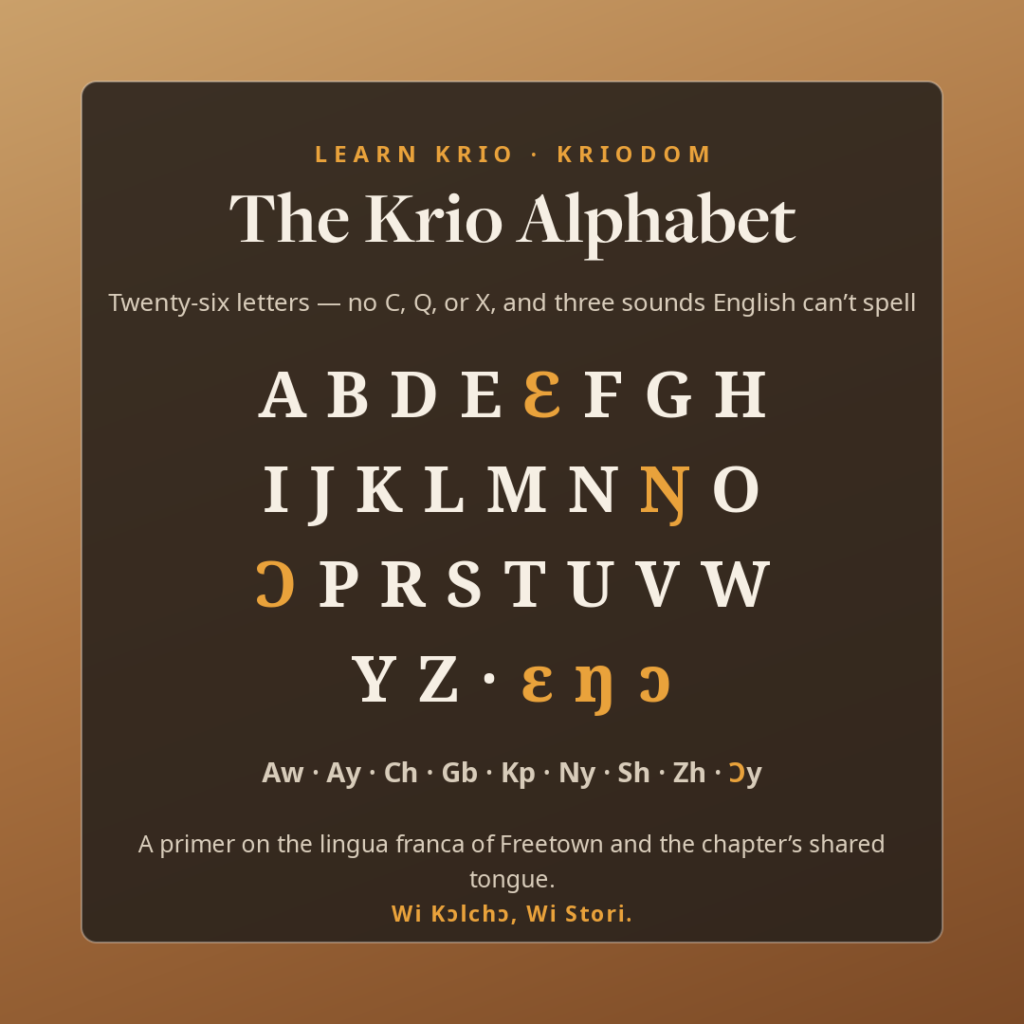
The Krio alphabet
The Krio alphabet

A note on spelling

Krio has a standardized orthography developed by the Krio Language Academy, though older spellings (used in family letters, hymnals, and street signage in Freetown) persist. On this site we use the standardized spelling — except where a phrase has a traditional KDU-chapter spelling worth keeping.

Family lettersHymnalsStreet signage
HERITAGE — LANGUAGE

Krio — a primer.

An English-based creole, born in Freetown, carried wherever Krios have travelled. A few phrases to start.

Krio is the native language of the Sierra Leone Creole people (the Krios), and the lingua franca of Sierra Leone. It draws from English, Yoruba, Portuguese, French, and the West African languages of the freed slaves and liberated Africans who founded Freetown in the late 18th and early 19th centuries.

Common phrases
  • Kushe — informal hello.
  • Aw di bodi? — how are you? (lit. how’s the body?)
  • Tenki ya — thank you very much.
  • Padi — friend.
  • Wi na wan — we are one.
  • Le we hep we sef — let us help one another. (The chapter motto.)
  • A Bo — Disappointment.
  • Mi nem na ___ — my name is ___.

A note on spelling

Krio has a standardized orthography developed by the Krio Language Academy, though older spellings (used in family letters, hymnals, and street signage in Freetown) persist. On this site we use the standardized spelling — except where a phrase has a traditional KDU-chapter spelling worth keeping.

Want to learn more?

The Akintola Wyse Symposium series often features sessions on Krio language and literature. Members of the chapter teach informal Krio classes from time to time — email board@kduoftexas.org if you’re interested.